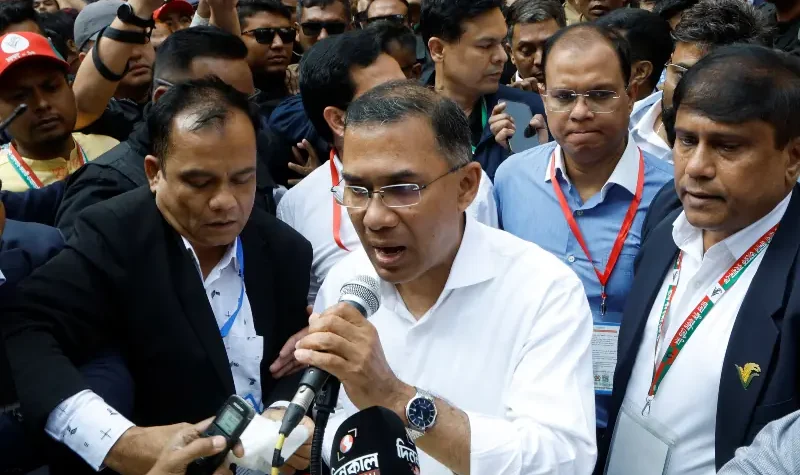
Dhaka, February 13, 2026 (Reuters) – The Bangladesh Nationalist Party (BNP) won a commanding two-thirds majority in Friday’s general elections, a result widely expected to bring stability after months of turmoil following the ouster of former Prime Minister Sheikh Hasina in the Gen Z-led uprising of 2024.
Preliminary counts from what was seen as Bangladesh’s first genuinely competitive election in years indicate that the BNP and its allies have secured at least 212 of the 299 contested seats, according to domestic television channels.
The opposition Jamaat-i-Islami and its allies won 70 seats in the Jatiya Sangsad, the nation’s parliament. The Election Commission currently records the BNP with 181 seats, Jamaat-i-Islami with 61, and others with seven seats, with full official results not expected before Friday noon (11am PKT).
Returning to power after 20 years, the BNP expressed gratitude to the people and called for special prayers on Friday for the nation and its citizens. The party stated, “Despite winning by a large margin of votes, no celebratory procession or rally shall be organised.”
The National Citizen Party (NCP), led by youth activists who played a key role in Hasina’s removal and contested as part of the Jamaat-led alliance, won only five of the 30 seats it contested.
A decisive result was viewed as critical for stability in the Muslim-majority nation of 175 million, where months of anti-Hasina unrest had disrupted daily life and industries such as garment exports, in which Bangladesh ranks second globally.
“A strong majority gives the BNP the parliamentary strength to pass reforms efficiently and avoid legislative paralysis. That alone can create short-term political stability,” said Selim Raihan, economics professor at the University of Dhaka, in an interview with Reuters.
BNP leader Tarique Rahman is widely expected to be sworn in as prime minister. The son of the party’s founder, former president Ziaur Rahman, Tarique returned to Dhaka in December after 18 years abroad.
In its manifesto, the BNP pledged to prioritise job creation, protect low-income and marginal households, and ensure fair prices for farmers.
“If the factories run regularly and we receive our wages on time, that’s what matters most to us. I just want the BNP government to bring back stability so more orders come to Bangladesh and we can survive,” said Josna Begum, 28, a garment worker and mother of two, following the results.
Shafiqur Rahman, Ameer of Jamaat-e-Islami Bangladesh, attended a press conference after the election, acknowledging the trend of defeat but stating that the party was “not satisfied” with the process and urging supporters to remain patient.
Sheikh Hasina, now in exile in New Delhi, had long dominated Bangladeshi politics along with Tarique Rahman’s mother, Khaleda Zia, while his father was a leading independence figure who ruled from 1977 until his assassination in 1981.
The BNP’s victory with over 200 seats marks one of its largest wins, surpassing the 193 seats won in 2001. By comparison, Hasina’s Awami League, barred from contesting this time, had won 230 seats in 2008. Past elections were often boycotted by major parties or marred by disputes.
Overnight, thousands of BNP supporters celebrated at the party headquarters in Dhaka, chanting slogans as the scale of the landslide became clear. Voter turnout exceeded 42 percent from the 2024 election, with media reporting that nearly 60 percent of registered voters participated.
COAS reiterates resolve to eliminate terrorists, warns against use of Afghan soil
RAWALPINDI (RNN TV) — Chief of Army Staff (COAS) and Chief of Defence Forces (CDF) F…





CSS Exam 2026: Age Limit Relaxed, Essay Paper Gets New Focus
The Senate Standing Committee on Delegated Legislation has asked the Federal Public Service Commission …