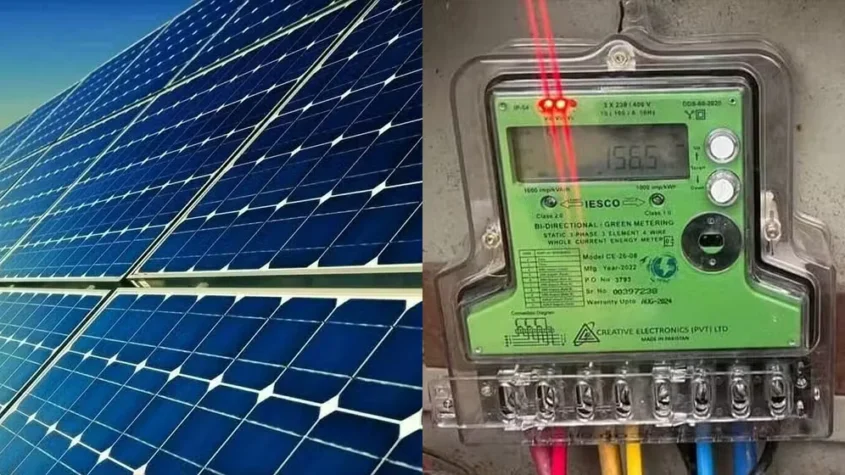
ISLAMABAD (Web Desk) — The federal government has halted the implementation of its decision to shift electricity consumers from net metering to net billing following criticism and public backlash, Minister for Power Division Awais Leghari informed the National Assembly on Thursday.
Addressing lawmakers, the minister said the government had also decided to file an appeal against the regulator’s determination, adding that the debate surrounding net metering should be seen within the broader framework of ongoing power sector reforms.
Mr Leghari told the house that the government had reduced the circular debt by Rs780 billion and renegotiated agreements with independent power producers (IPPs), resulting in financial relief amounting to Rs3,400 billion. He said tariffs of several IPPs had been revised downward, and claimed that even a project linked to a relative of the prime minister had undergone cuts of Rs100 billion.
He further stated that electricity tariffs for industrial consumers had been reduced in a bid to support economic activity.
Referring to net metering, the minister noted that the mechanism was introduced in 2017 and had since undergone multiple regulatory revisions. He said the matter had been taken up by the Economic Coordination Committee and later by the federal cabinet, adding that the government retained the right to challenge the regulator’s decision through an appeal.
According to the minister, the country’s total installed solar capacity currently ranges between 20,000 and 22,000 megawatts. Of this, approximately 6,000 megawatts fall under net metering, while around 7,000 megawatts are part of the industrial and commercial segment. Nearly 700,000 consumers are presently benefiting from net metering, he added.
Mr Leghari questioned the sustainability of purchasing electricity at Rs27 per unit under net metering when power from other sources was being procured at an average of Rs8 per unit. He observed that nearly 35 million consumers were not on net metering and asked whether the policy was equitable for the wider public.
He also highlighted disparities in adoption, stating that most solar installations in Islamabad’s urban sectors operated under net metering, while many systems in suburban localities did not. Overall, he said, only 8 to 10 per cent of consumers nationwide were using net metering.
During the question hour, the Power Division disclosed that out of 12,665 feeders across the country, 2,223 were experiencing load shedding exceeding 10 hours. The situation was described as most severe in areas served by the Quetta Electric Supply Company (Qesco), where 604 of 814 feeders were affected.
Similar prolonged outages were reported on 407 of 707 feeders under the Sukkur Electric Power Company (Sepco), 174 of 357 feeders under the Tribal Areas Electric Supply Company (Tesco), and 642 of 1,376 feeders under the Peshawar Electric Supply Company (Pesco).
By contrast, the Lahore Electric Supply Company (Lesco), Islamabad Electric Supply Company (Iesco), Gujranwala Electric Power Company (Gepco), and Faisalabad Electric Supply Company (Fesco) reported no feeders facing load shedding beyond 10 hours.
The minister further revealed that transmission losses over the past two years had exceeded Rs600 billion. Losses stood at Rs322 billion in FY24 and Rs284 billion in FY25. Pesco recorded the highest losses at Rs96 billion, followed by Qesco at Rs51 billion, Lesco at Rs46 billion, Sepco at Rs37 billion, and the Hyderabad Electric Supply Company (Hesco) at Rs22 billion.
Between July and December 2025, consumers used 8.78 billion units of electricity. The total number of electricity consumers across 11 distribution companies reached 39.22 million, while the number of protected consumers rose to 21.55 million, compared to 9.5 million in October 2021.
Mr Leghari said capacity under net metering had reached 7,000 megawatts by December 2025, while off-grid solar capacity stood at 12.62 megawatts.
He also informed the house that electricity consumers were paying Rs310 billion annually to service circular debt. Agreements with several IPPs had been revised, with the resulting financial relief passed on to consumers, while negotiations with others remained underway. Additionally, projects amounting to 7,967 megawatts of high-cost electricity generation had been cancelled.



COAS reiterates resolve to eliminate terrorists, warns against use of Afghan soil
RAWALPINDI (RNN TV) — Chief of Army Staff (COAS) and Chief of Defence Forces (CDF) F…



CSS Exam 2026: Age Limit Relaxed, Essay Paper Gets New Focus
The Senate Standing Committee on Delegated Legislation has asked the Federal Public Service Commission …